School exclusion in Pakistan’s major cities
Gulmina Bilal Ahmad
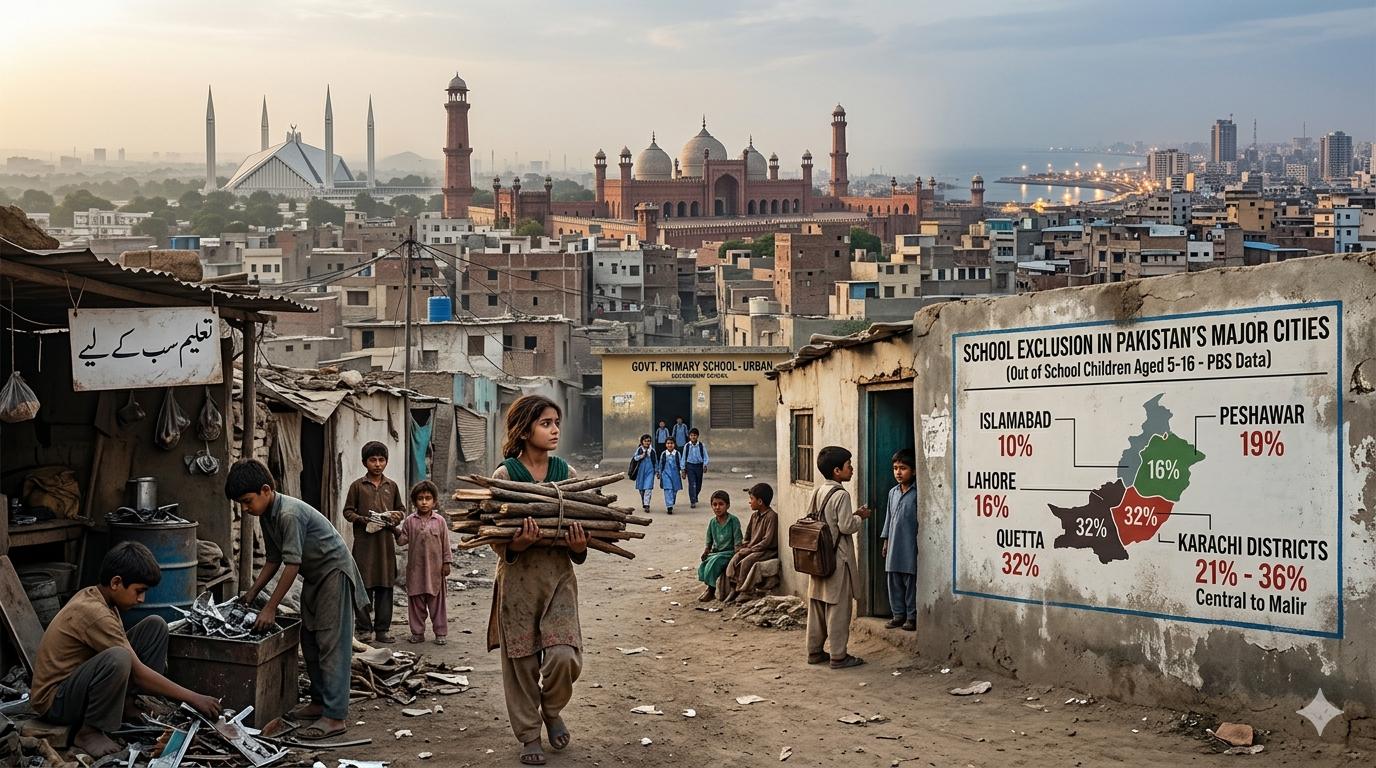
Pakistan does not publish an official, city by city table of drop out rates for its provincial capitals and Federal capital. The closest official dataset is the Pakistan Bureau of Statistics district table on % of out of school children aged 5-16.
It shows Islamabad at 10%, Lahore at 16%, Peshawar at 19% and Quetta at 32% for urban out of school children. Karachi is fragmented across multiple districts ,with urban rates ranging from 21-36% depending on district i.e. Karachi Central:21%, East 22%,Karachi: 22%,Korangi : 23%,West :29% and Malir : 36%%
Nationally , the scale of exclusion remains severe. UNICEF Pakistan says 25.1million children aged 5-16 are out of school ,equal to 35% of that age group. Annual Status of Education Report (ASER) states 26.2million. District Education Performance Index (DEPIx) reports 25.61million and notes that roughly 79% of them have never enrolled, which matters because the policy response for never enrolled children is different from response for children who dropped out.
For these five cities, the most comparable indicator is urban out of school children (OOSC) ages 5-16 , not dropout alone. Dropout captures children who left after enrolling; out of school includes both dropouts and those who never entered. This distinction is critical because most excluded children are not re-entry cases but never enrolled cases.
Islamabad performs best among the five on this measure at 10% urban OOSC but still means roughly 1 in 10 children of school age is out of school in the federal capital. The issue here is less basic access than persistence, quality and inclusion for the last mile.
Lahore stands at 16%.This suggests that in Lahore the system challenge is less about geographical access and more about retention, quality, household poverty and public confidence in public schools.
Peshawar records 19% urban OOSC while recent provincial government figures quote over 500,000 children in Peshawar were out of school in 2025, indicating the burden remains extremely large in absolute terms even where the percentage is not the country’s worst.
Quetta is the weakest performer among the five at 32% urban OOSC, about double Lahore and more than triple of Islamabad. This aligns with the broader Balochistan pattern , where the province’s urban rate is 35% and total rate 47%. Quetta should therefore be treated as a high priority urban exclusion zone, not an average city case.
In Karachi, district conditions diverge sharply. The core urban districts cluster around the low 20s but West and especially Malir are far worse. Karachi dropout rate hides the city’s real story: exclusion is concentrated in the periphery, informal settlements and poorer expansion zones.
The five city picture is not one problem but at least four :
Capital city residual exclusion: Islamabad shows that even in the country’s strongest urban education environment, universal education has not been achieved.
Large city inequality: Karachi’s spread from 21% -36% shows that city averages conceal major internal disparities
Urban poverty and fragility: Peshawar suggests that conflict legacy, migration and household poverty continue to shape exclusion
Structural provincial disadvantage: Quetta’s rate is not simply a city management issue; it reflects the wider educational deficit of Balochistan.
Immediate steps to be taken city wise are :
For Karachi: Target Malir and West first with ward level mapping, second shift schools , transport support for girls and accelerated non formal learning for overage children. A single city wide campaign will underperform unless resources are concentrated where exclusion is highest.
For Quetta: Treat the city as an emergency inclusion zone. Priorities should include girl’s access, safe school routes, teacher deployment and re entry plus second chance programs.
For Peshawar: Pair enrolment drives with retention support such as stipends, school meals and re-engagement of children already in or near labour markets. Annual drives alone are not enough.
For Lahore and Islamabad: Shift to harder problems of retention, transition from primary to middle, learning quality and the children who remain excluded despite favourable urban conditions. These cities are better positioned to pilot data led retention systems.
Nationally: Separate policy for never enrolled and dropout children. DEPIx’s finding that nearly 79% of OOSC have never enrolled means Pakistan cannot solve the crises with dropout recovery alone. It needs early enrolment drives, pre-primary access and neighbourhood level identification of children who never entered school.
The cleanest current policy takeaway is this: among the five major cities, Islamabad performs best, Lahore is relatively better but still far from universal schooling, Peshawar remains under heavy pressure, Quetta is a high exclusion category and Karachi is deeply unequal across districts.